
Thought acting at distance
In a Connected Universe, to what extent do our thoughts effect change in the Cosmos?

I’ll state up front that I’m exploring some Electric Universe ideas here and none of this will make any sense in a Standard Model paradigm, we’re still waiting for it to shift. But these are some fringe ideas which stray into areas usually branded pseudoscience or paranormal. No surprise there.
Michael Clarage published a really interesting article entitled Unpredictability which asks the following simple and at the same time, mind-boggling question.
Take an every day occurrence: I can desire to reach for my cup, and presto! millions of cells obey that impulse, and the cup is grabbed. How does this happen? How is matter affected by a desire?
That’s a pretty tough nut to crack! Fabulous question though and it resonated with me concerning a couple of questions I have pondered on.
Can anything be truly random in a Universe with Cause and Effect?
In a former life as a software engineer, I would often run into problems with random numbers. You would imagine asking a computer to produce a random number would be a simple thing, but it is not, and it is a branch of computer science that is quite arcane.
The problem is that there is no (known) mathematical function for randomness. Complicated software algorithms are used to fake this behaviour, these generate pseudo-random numbers sufficient for databases or computer games, but problems can occur. Roll a million dice and record the numbers on a graph and compare with a million computer generated numbers and you will see the distribution is not the same. Online gamblers might be right to ask, how random was that card-shuffle?

But given we don’t have a function for randomness, perhaps the better question to ask is, does randomness even exist?
“There are no coincidences, only the illusion of coincidences.”
Cause and Effect is a fundamental concept in science, but randomness would seem to challenge the idea. Quantum Theory has it’s own explanations for how the microscopic world can only be described in terms of statistical probabilities and that this uncertainty is responsible for randomness.
But Electric Universe theory does not use Quantum Theory, in fact it does not have a separation of physics between the macro and micro world at all.
But this is why I raise the question, does randomness exist? Without Quantum Uncertainty, we are left with a paradox to explain randomness.
It is my opinion, that true randomness does not exist. It is as artificial a concept as Time. But as Michael explains in his Unpredictability article, that does not mean that you can determine the state of the Universe to predict the future course of events. You would have to Stop the Universe to even attempt to measure its state, it is constantly in motion, flowing with energy, matter is in continuous creation and destruction. I doubt even God would have the patience for such a calculation. Scientists could not even measure the exact state of a peanut, let alone the Universe.
If there is no randomness in the Universe, then there must be a means and a medium to convey all that information across the Cosmos for it to remain consistent in real time.
But this brings me to my second and more speculative question, the subtitle of this article.
In a Connected Universe, to what extent do our thoughts effect change in the Cosmos?
Here I am borrowing some ideas from the great Wal Thornhill and many other EU contributors, concerning the electro-magnetic model of Gravity, the speed of information in the Cosmos and action at a distance being a consequence of electric fields.
In the EU model, the Universe is Connected.
This simple statement has titanic implications. There are no islands in space, Wal famously stated.
We are not living on a planet that floats through a void, obeying a weak Gravitational attraction to keep it in orbit of the Sun, but otherwise disconnected from all the other stars and planets.
We are rather part of the vast body of the Universe, connected to the whole exactly as our cells are connected to our body, precisely because of the same laws of electro-magnetism. This is the force that shapes our Universe, this is the force that keeps the planets in their orbits or sometimes displaces them, this is the force that defeats entropy to create precise arrangements of matter, like Saturn’s ring system or the geometry of weather systems. You can’t do those things with Gravity alone and indeed Gravity is such a trivial actor at cosmological scales it is not worth regarding it, the galaxies certainly don’t.
So then, a vast Universe as a connected body, comprised of 99.99% plasma with huge electric currents flowing through the plasma, producing the magnetic fields that pull matter into the filamentary Cosmic Web and pinch matter into new elements, planets and stars.
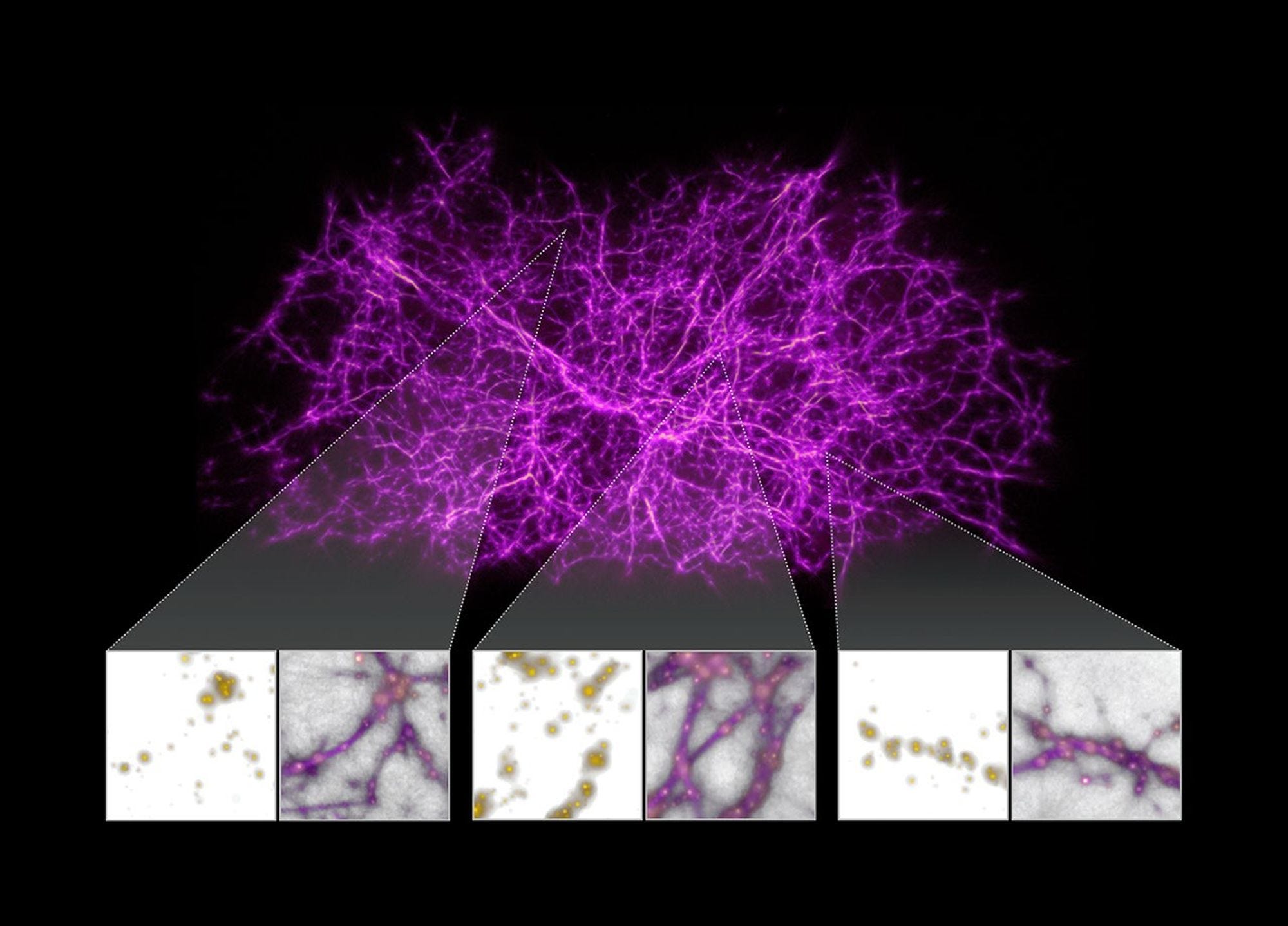
The electric field spans the Universe.
Disturbances in the electric field, such as the movement of stars and planets, even atoms, communicate across the electric field at the speed of information, near instantaneous in other words. (How that works is explained by Wal in the links included above - it’s no easy thing to get your head around and he presents it far better than I could hope to.)
So in a sense, not only are we directly connected to the Universe in real time, our actions and activities affect the Universe in real time.
This makes me wonder, are our electrical thoughts also emitting waves in the electric field of the Universe?
Rupert Sheldrake has researched the problems of consciousness, memory and biological form for decades, he has published many excellent books on the topics. Some of the areas of his research are considered paranormal despite statistically significant evidence by repeatable scientific tests.
I value his work very highly and I share his opinion that our consciousness is not confined to electro-chemical activity in the brain.
In my opinion, the brain is the focus of a natural fractal antenna comprised of our body as a whole, but flowing the received energy and information down to every cell nucleus. We absorb and emit electro-magnetic waves continuously, the waves contain energy and information.
Most of this information is noise, the hum of billions of cells, but we focus on some wavelengths with our senses and I think our consciousness is the experience of our fractal antenna being tuned-in to the Cosmos in real time, and this is the sense that we disconnect from when we sleep, our bodies continue to run, but we are not tuned-in to the Cosmos.
I think this idea of consciousness not being confined to the brain goes a long way to explain many paranormal experiences, such as telepathy, remote viewing, lucid dreaming, miraculous inspiration and perhaps even telekinesis. It may also be, expressed in a spiritual sense, how body and spirit and soul come together as one.

Finally, to return to Michael’s mind-boggling question, “How is matter affected by a desire?”
I will make a heroic stab at answering this, but it is almost too hard to contemplate.
It begins with our thought, our desire or intention. This thought emits a wave of information through our body, it commands us into action, nerves fire, tendons pull on limbs and we are in motion. It would be too complicated to describe the exact sequence, like learning to walk, our bodies work it out and remember so we can do it unconsciously.
But what really matters is that our thought created action at distance. The distance was limited to the extent of our body, but this is still a significant distance.
That thought made a very small, non-random change to the Universe in real time. It begs the question, what else can we influence with our thoughts?
We have exactly zero influence on the universe.