
Severe geomagnetic storms strikes Earth
TASS

The sun exploded with a powerful X1.9 flare on the evening of January 18, launching a huge blob of solar material, known as a coronal mass ejection, towards the Earth
MOSCOW, January 19. /TASS/. A powerful geomagnetic storm began on Earth when the blast of solar particles released during the first solar flare of the highest X class in 2026 reached the atmosphere, the Institute of Applied Geophysics has told TASS.
At present, the storm is classified as tier two (G2) on a five-tier scale, where G5 is the most powerful.
The sun exploded with a powerful X1.9 flare on the evening of January 18, launching a huge blob of solar material, known as a coronal mass ejection (CME), towards the Earth. It was projected to trigger strong geomagnetic storms that could reach the G4 level.
https://tass.com/science/2073387
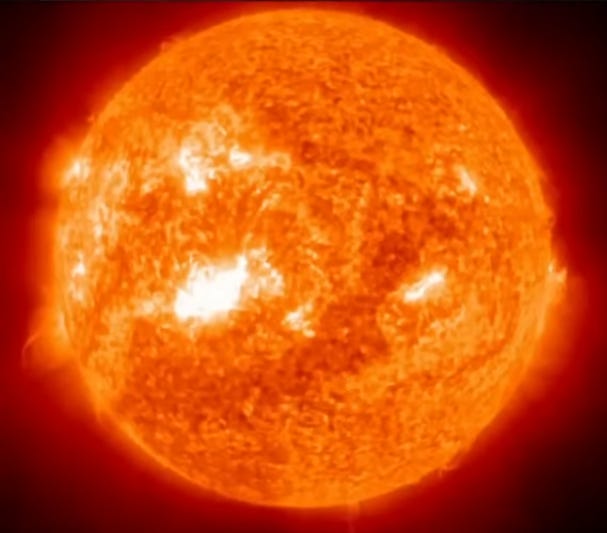
This was not only an Earth-directed flare, it was also a long duration flare, releasing an enormous amount of radiation and throwing off a large Coronal Mass Ejection our way.
Geomagnetic storm conditions are likely to peak within 24 hours and together with the ongoing planetary alignments, we are at an even higher risk of seismic activity.
If conditions reach G4 or higher as anticipated, we could see widespread radio interference (you can hear it through your car radio), disruptions to the power grids including transformer failures and electrical fires, disruption or even fatal damage to satellites including GPS systems, computer network failures, and a host of biosphere effects that can impact all living things.
Australian Bureau of Meteorology
Tuesday 20 January last updated 19/2324 UT
G4 planetary and Australian geomagnetic conditions have been observed due to a coronal mass ejection (CME) arrival. G4 planetary geomagnetic conditions are expected, with a chance of G5. Solar flare activity on UT day 20-Jan is expected to reach R1-R2 levels. S2 solar radiation storm conditions are currently ongoing and are expected to continue into 20-Jan, with a chance of S3. The solar wind speed is expected to be very strong over the UT day. HF radio propagation conditions are expected to be poor across the Australian region. Maximum usable frequencies (MUFs) in the Australian region are expected to be depressed by 25-50%. Shortwave fadeouts are possible.
https://www.sws.bom.gov.au/
These are the latest Space Weather updates with all the details:
Magnetic storm on Earth reaches G4 level for first time since November 2025 — scientists
The Institute of Applied Geophysics uses a scale of five levels, where G5 is "extremely strong" and G1 is "weak"
MOSCOW, January 20. /TASS/. The magnetic storm, which began after the impact of a plasma cloud from the first X-class flare on Earth in 2026 reached a G4 level, an official at the Institute of Applied Geophysics (IPG) told TASS.
The IPG uses a scale of five levels, where G5 is "extremely strong" and G1 is "weak."
The Laboratory of X-Ray Astronomy of the Sun confirmed the level. "It has been officially confirmed that a G4.33 planetary magnetic storm is taking place on Earth. The only indicator of the solar wind that is currently being measured correctly is magnetic field induction, which shows values close to historical records," the laboratory said in a statement.
The last time a storm of this level was observed was on November 12 last year, when the Kp geomagnetic index peaked at G4.3-G4.7.
The G4 level assumes that on Earth, besides serious interference in communications, serious radio communication disruptions, multi-hour satellite and radio frequency navigation disruptions can be recorded. Auroras can be recorded even in the tropics.
The first class X flare this year occurred on the evening of January 18 and was accompanied by the release of a plasma cloud towards the Earth. It was expected that the impact would provoke magnetic storms up to G4.
https://tass.com/science/2073421
There is currently Live coverage here:
A Near-Carrington Level Solar Storm Just Hit Earth 💥 Breaking Space Weather News
https://youtu.be/8LRxuH1LDAs